
Clinton County Court Records After Arrest
The arrest-to-court path in Clinton County runs through Pennsylvania's magisterial district courts and the Court of Common Pleas. A person arrested in Clinton County may be processed at Clinton County Correctional Facility or through central processing, then appear before a Magisterial District Judge for a preliminary arraignment or first appearance. The Clinton County court schedule uses Central Court entries marked "First Appearance," which shows that post-arrest matters are placed into the county court workflow rather than left only as jail intake events.
That distinction matters. A booking record may show that someone was received into custody, but Clinton County court records after a jail arrest show the case that follows. The prosecutor may file, amend, withdraw, reduce, or add charges after police make an arrest. For current custody and booking status, use Clinton County jail inmate records. For booking photos, use Clinton County jail mugshots. For filed charges, docket events, bail entries, and dispositions, use the court record sources listed below.
Search Clinton County Court Records
The official first stop is Pennsylvania UJS Case Search. UJS is the statewide public docket system for Pennsylvania courts. It can search by participant name, docket number, offense tracking number, complaint number, incident number, citation number, organization, state ID, and other case categories. For a Clinton County arrest, narrow the search to Clinton County and choose criminal or magisterial court filters when the portal offers them.
The UJS case information page describes public docket sheet searches and case identifiers. Search by name when no paperwork is available. Search by OTN, docket number, complaint number, or incident number when jail paperwork, a citation, a criminal complaint, or a court notice gives one of those numbers. Dockets may appear after the first court filing rather than at the exact moment of booking, so a very recent arrest can require a later search or a call to the jail or court office.
- Open the UJS case-search portal and choose a criminal or magisterial search path when available.
- Search by participant name first, then narrow to Clinton County.
- Use OTN, complaint, incident, citation, or docket number if the name search returns too many matches.
- Open the docket sheet and read each listed charge, grade, statute, filing date, hearing, bail entry, and disposition.
- Check later if the arrest was recent, because the court record may lag behind jail processing.
The screenshot below shows the official UJS case-search interface used for public docket lookup. Open UJS Case Search from the court portal before relying on any third-party case summary.
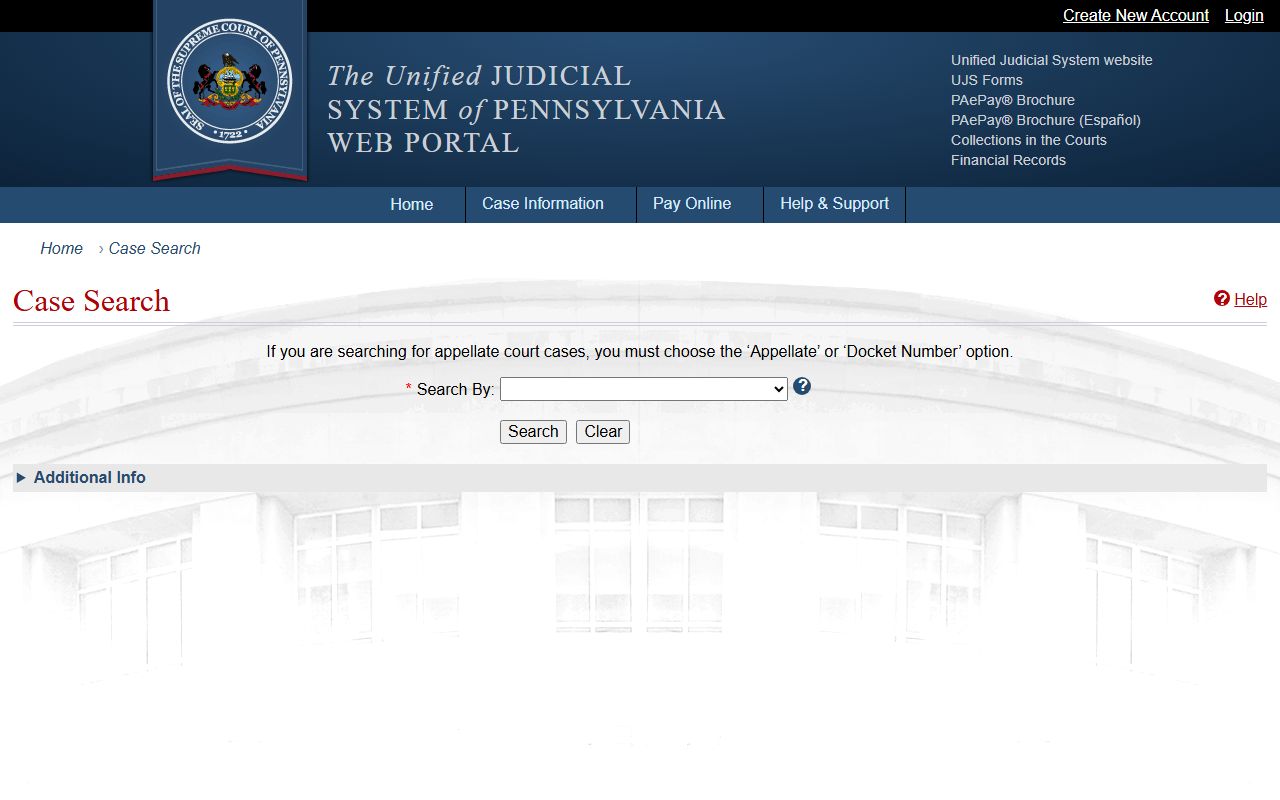
UJS is a docket search, not a jail roster. It is strongest for formal court records after an arrest, while VINE and the facility phone line are better for current custody confirmation.
Clinton County Arrest Case Fields
UJS has several search paths that help connect a Clinton County jail arrest to a court case. Name searches work when only the defendant's name is known, but number searches are more precise. An OTN, complaint number, incident number, citation number, or docket number can reduce false matches and can tie a booking, warrant, or police complaint to the later court record.
| Field Label | Type | Required | Notes |
|---|---|---|---|
| Search By | Dropdown | Yes | Official categories include docket number, participant name, OTN, complaint number, incident number, citation number, organization, state ID, and calendar event. |
| Court / Court Type | Filter | No | Use criminal, magisterial district, or Common Pleas filters when visible. |
| County | Filter | No, but recommended | Select Clinton County to avoid unrelated Pennsylvania cases with similar names. |
| Participant Name | Text | Depends on search type | Use the defendant's legal name and try spelling variants when needed. |
| Docket / OTN / Complaint / Incident | Text | Depends on search type | Use the exact identifier from police, jail, citation, or court paperwork. |
Clerk Records and Infocon
The Clinton County Prothonotary and Clerk of Courts is the local criminal filing office for the Court of Common Pleas. The office is at 230 East Water Street, Lock Haven, PA 17745, can be reached at 570-893-4007, and lists Prothonotary@ClintonCountyPA.Gov as its email contact. County research says criminal and civil court records date back to Clinton County's origin in 1839, and the office handles entry, documentation, fee collection, and maintenance of court files.
Clinton County also describes Infocon online public records access. The county says most public access records are online, including more than 200,000 scanned documents. For Clerk of Court records, Infocon includes docket information, scanned documents relating to a case or arrest, and judgments. The county identifies Infocon as a fee-based service, so UJS remains the better free first search, while Infocon or the Clerk of Courts can help when a scanned complaint, arrest paper, judgment, or older filing is needed.
Charges After a Clinton County Arrest
The Clinton County District Attorney is the prosecutor for misdemeanor and felony cases before the Clinton County Court of Common Pleas. The county page names Dave Strouse as District Attorney and says he has served since 2016. The DA's office assists municipal and state police with investigations and works with Adult and Juvenile Probation, Mental Health and Intellectual Disabilities, Children and Youth, Office of Aging, Clinton County Correctional Facility, and state agencies. After an arrest, the charge record becomes a court matter when a criminal complaint, information, or other charging document is filed and the docket starts to track the case.
| Complaint | Information | Indictment | |
|---|---|---|---|
| Filed By | Police or prosecutor, depending on the case stage | Prosecutor | Grand jury |
| Common Use | Initial criminal case filing and magisterial proceedings | Formal Common Pleas filing after charges are held for court | Less common route for serious or grand-jury matters |
| What It Shows | Alleged conduct, statute, grade, date, and tracking numbers | Charges the Commonwealth moves forward in higher court | Charges returned through grand-jury action |
| Why It Matters | Connects the arrest to the first court record | May differ from booking or complaint allegations | Can replace or supplement earlier charging papers |
Clinton County Charge Status
Charge status can change as a Clinton County court record moves forward. Police may arrest on probable cause or on a warrant, while the DA may decide what charges to file in court. A jail booking allegation may not match the final filed charge. UJS docket sheets are useful because they can show whether a charge is pending, held for court, amended, withdrawn, dismissed, resolved by plea, sentenced, or closed.
| Status | What It Means |
|---|---|
| Pending | The charge is still active, and the docket should be checked for the next hearing, filing, or bail event. |
| Held for Court | A lower-court stage found enough basis for the charge to proceed toward the Court of Common Pleas. |
| Amended / Reduced | The prosecutor or court changed the charge, grade, or wording, so the booking allegation may no longer match the filed case. |
| Withdrawn / Dismissed | The charge is not proceeding in its listed form, though other charges in the same case may remain active. |
| Nolle Prosequi | The Commonwealth declines to pursue the charge, usually by formal docket entry or court approval. |
| Guilty / Sentenced / Closed | The docket reflects a plea, verdict, sentence, or final case status rather than a mere accusation. |
Bail Records After Arrest
Pennsylvania bail decisions are court-driven. After a Clinton County arrest, a Magisterial District Judge or the Court of Common Pleas may set release conditions. The VINE custody path is not the best bail record because Clinton County does not publish a local roster with per-charge bail fields in the located sources. For bail, use UJS docket sheets first, then confirm the practical release status with the jail, the Clerk of Courts, or the appropriate Magisterial District Court before attempting to post money.
| Release Type | How It Works |
|---|---|
| Recognizance | The person is released on a promise to appear and obey conditions. |
| Unsecured Bail | No upfront payment is made, but a set amount may be owed if release terms are violated. |
| Monetary Bail | A court sets a money condition that must be posted through the proper court or approved route. |
| Nonmonetary Conditions | Release may depend on supervision, no-contact orders, treatment, travel limits, or other terms. |
| Hold / Detainer | Another legal reason, such as probation, parole, ICE, a bench warrant, another county, or federal custody, may block release. |
For someone physically at Clinton County Correctional Facility, the practical order is to confirm custody through Pennsylvania VINE or 570-769-7680, identify the court case in UJS, read the bail entry, then call the court or jail before travel. If the person is held for ICE, a county criminal bond may not release the person from immigration custody. ICE points immigration-court questions to 1-800-898-7180, while local ICE detainee information for the Clinton facility is routed through 570-547-6903 during posted hours.
Warrants and Arrest Records
The Clinton County Sheriff's Office has an official warrant channel through CRIMEWATCH warrants and a county sheriff warrant page. Sheriff posts often state that the office holds an active bench warrant for a named person and direct the public to submit a tip or call 570-893-4070. CRIMEWATCH can show warrant entries, most-wanted posts, and sometimes arrest posts, but it is not a complete court docket and it is not a current jail roster.
When a warrant leads to a Clinton County arrest, several records may exist at once. The sheriff's warrant post may show the warrant notice. VINE may show custody if the person is held at the correctional facility. UJS may show the underlying court case, hearing, bail action, or bench-warrant event. The Clerk of Courts may hold file documents, and county Right-to-Know may apply to non-judicial agency records. For official warrant questions, the Sheriff's Office is at 230 East Water Street in Lock Haven and lists 570-893-4070 as its office phone.
Charges vs Convictions
A Clinton County arrest and a filed charge are accusations. They are not the same as a conviction. A court record can be public while the case is pending, but the docket must be read carefully to see whether the charge was dismissed, withdrawn, amended, pleaded, tried, or sentenced. This is especially important when using court records after a jail arrest for personal research, family planning, or case tracking.
| Charge | Conviction | |
|---|---|---|
| Stage | An accusation filed after arrest or by later court paper. | A guilty plea, verdict, or other lawful finding of guilt. |
| Proof Level | Based on probable cause or formal filing standards. | Requires proof beyond a reasonable doubt or a valid plea. |
| Where It Appears | UJS docket, complaint, information, warrant, or jail paperwork. | Docket disposition, sentencing entry, and criminal history record. |
| Common Risk | Readers may mistake an arrest count for a final outcome. | Readers should still check sentence, appeal, and expungement status. |
Sealed or Expunged Records
Pennsylvania public access is shaped by the Right-to-Know Law, court access rules, and the Criminal History Record Information Act. The Pennsylvania Right-to-Know Law gives access to public records unless a statute, privilege, court order, or exception applies. CHRIA definitions and dissemination rules affect criminal history information, investigative material, intelligence information, treatment information, and eligible expungement records.
| Sealed / Restricted | Expunged | |
|---|---|---|
| Public View | Hidden or limited for most public users, depending on court order or rule. | Removed or treated as not publicly available after a qualifying order. |
| Agency Access | Some criminal justice agencies may retain limited access. | Access is more limited, but the exact result depends on the order and record type. |
| Eligibility | May apply to juvenile, protected, sealed, or otherwise restricted records. | May apply after dismissal, acquittal, pardon, or other qualifying events under CHRIA provisions. |
| Best Source | Court order, UJS visibility, Clerk of Courts, or the responsible agency. | The expungement order and the office that processed it. |
CHRIA dissemination limits at 18 Pa.C.S. 9106 and expungement provisions in the 18 Pa.C.S. 9122/9123 family should be checked before assuming a dismissed charge is still public or fully removed. Juvenile records, sealed charges, treatment material, and investigative records can have stricter limits than ordinary docket entries.
Record Use Limits
Public court records after a Clinton County arrest can help locate a case, read filed charges, check a hearing date, or understand a disposition. They are not a substitute for a certified criminal-history search, a court-certified docket, or legal advice. For formal employment, housing, credit, insurance, or tenant screening decisions, use a lawful FCRA-compliant process and verify the record with the originating court or agency.
Important: This resource is not a consumer reporting agency and cannot be used for FCRA-covered screening decisions.